|
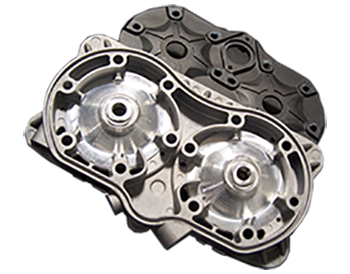
KTM\HUSQVARNA\BETA Overly Sensitive Carb Settings and Pipe "SOUNDS" |
|
KTM/BETA/HUSQVARNA Jetting Issues and Carb “Finicky-Ness” is not really a carb issue. New Buzz-Term “Pipe-Bang” also not a Carb issue.
Note: I am going to try and keep this VERY simple in order to get the points across. Intent is not to get into a fully involved technical discussion on what happens, but, rather, an over-view with some “liberties” taken as to exact internal engine function.
Much internet “chat” regarding the sensitivity of the carburetor with respect to temp and elevation changes. New buzz term “Pipe-Bang” has surfaced as well. Pipe Bang is said to happen when you are riding and suddenly chop the throttle (close) and coast while under gear loading. We, personally, have never experienced the phenomena, but it appears to be a real entity. BOTH of these “issues” are related and can be cured or, at least, lessened to a more normal/acceptable state of operation Let’s break it down to the “basics”, and get to the heart of what is happening, at least what we have determined. 1)The Mikuni Carb is not inferior to the Keihin NOR does have a greater sensitivity to elevation or temperature changes when compared to the Keihin. I know this may seem hard to believe, but, I can assure you, this is the case. BOTH carbs function EXACTLY the same in terms of fuel metering. They both work great! Your Carb is NOT alive--> so it does not have "feelings". It is ,therefore; not sensitive. 2) The real issue is related to engine mis-fires. The VERY poor OEM head (combustion chamber) design is prone to many engine mis-fires. Engine mis-fires are the result of trapped Fuel/Air (F/A) Mix NOT being 100% combusted during the combustion phase of the engine. These mis-fires cause un-burnt Fuel/Air (F/A) Mix to “linger” and travel to different parts of the engine (ie pipe, crankcase etc). When these F/A mix make its way back down into the crankcase, it causes some charge impurity and dilution. This will weaken the next charge and can cause an overly rich condition. This same F/A Mix can also contribute to more mis-fires due to the Air/Fuel Ration being incorrect for proper combustion. This will usually manifest itself (from a rider’s view) as a rich carb condition (blubber etc). This cycle repeats itself over and over and causes much “un-happiness” to the rider. This translates to the rider blaming the carb manufacturer and lobbing profanities at them as to their “poor” product and its inability to obtain and maintain proper jetting. 3) Pipe-Bang… This is a term I feel (and rightly so) will never make it into any SAE papers or textbooks. It only exists as a result of one or more poorly designed components attached to any given engine. While in this modern time, we would hope that engine components would not mimic those from the 2-Strokes infancy (60’s and 70’s era), unfortunately, this is not the case with these new Enduro Engines. What is causing the Pipe-Bang? SAME as what is causing the carb sensitivityà Engine Mis-Fires and an exhaust system that is out of resonance. These mis-fires will allow un-burnt F/A mix to enter the exhaust system. The exhaust will then “house” them, bouncing them back and forth within itself. Eventually, they will get ignited and explode within the pipe vs. on top of the piston where it could do some “good”. These “in-pipe” ignitions/explosions will do what all explosions doà “BANG”. We have determined that engine mis-fires are the cause of carb issues and pipe-bang (I hate using that word!). What is causing these mis-fires?? Mis-Fires are the result of incomplete combustion. The incomplete combustion is a result of a VERY poor factory combustion chamber design AND an exhaust that is out of resonance (ie unhappy). When the pipe is "unhappy" EVERYTHING else inside is effected. Fix the combustion chamber design and you fix the mis-fires (given proper jetting and ignition timing). You can still have mis-fires with a better chamber design. It is inherent with the 2-Stroke Engine but they will be MUCH less. Same with what would "appear" to be a carbthat is changing calibration... less mis-fires = less carb issues. In fact, we ride from 5,000ft to over 10,000ft nearly every ride we do. We also ride from 20F to 100F temperature throughout our riding season. I can tell you with 100% honesty, that we never make ANY carb adjustments! WHY? Because we have engines that are properly jetted and combustion chambers that are very efficient. IF any of you are experiencing adverse runability with temp changes or elevation changes, you have “other” factors that are causing these issues. You should NOT have to alter jetting as a result of a small elevation change or temperature change!! Even a large one (like we do).. IF you have an efficient combustion chamber that is not as prone to mis-fires! It, really, is that simple!! I’ll stop here, for now. Hopefully, this gave some clarity to these issues?
|

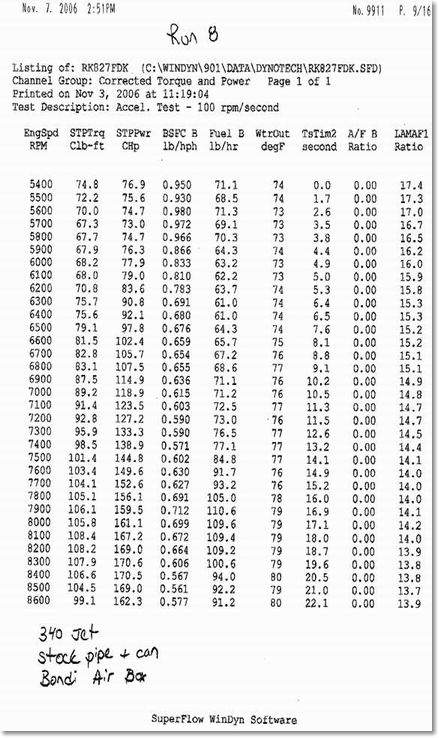
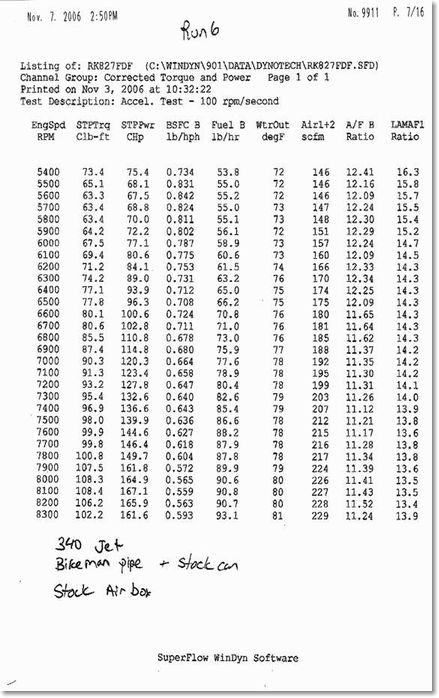
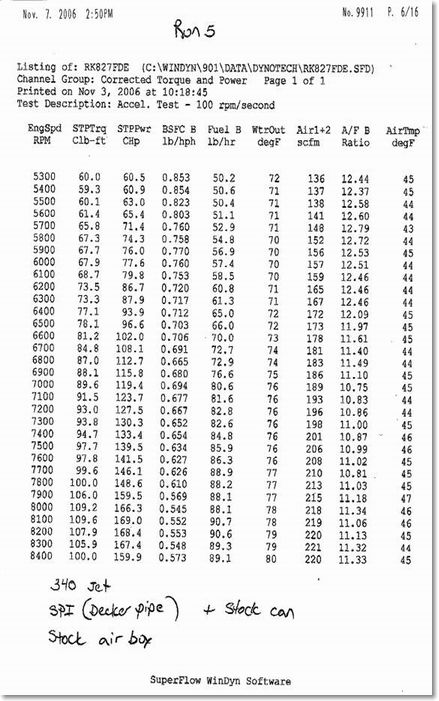
Nov. 2006 RKT 827 Dyno Run at Dyno Tech Research in New York
2004 Rev 827 MXZ
Independent CUSTOMER'S Run--> NOT RK Tek's Personal Engine
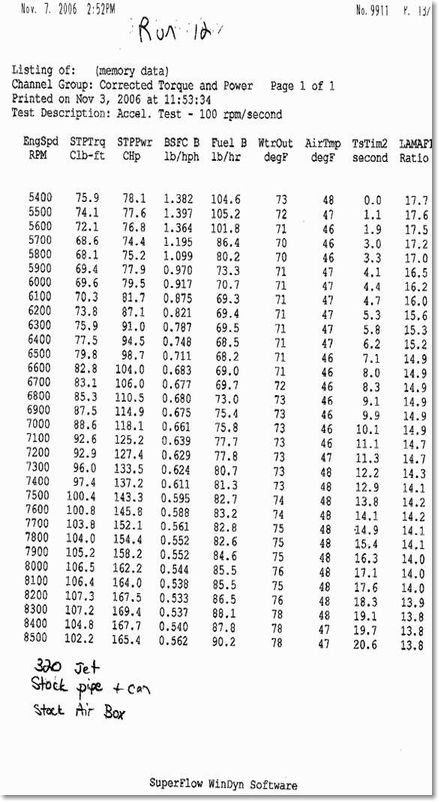
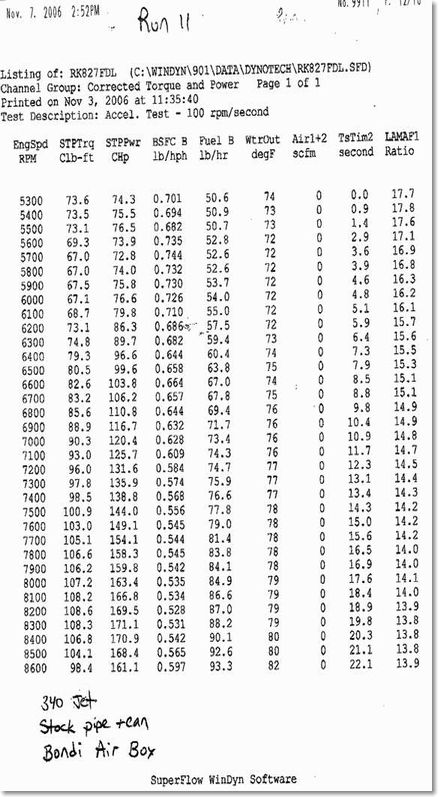
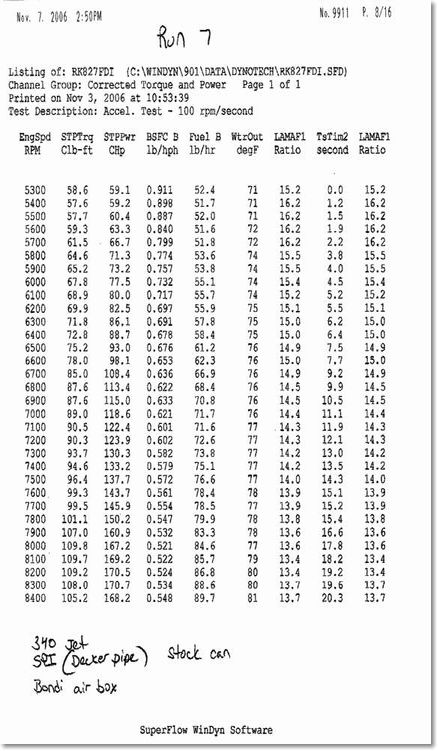
Below you will find the dyno results of one of our CUSTOMER'S 2004 827 engine builds. This engine was tested with the 3 different pipes.
1) Stock pipe and Can
2) BikeMan Pipe and Stock Can
3)Decker/Straightline Performance Pipe and Stock Can
This engine was run on 91 octane for 3 repeated 20+ second pulls with each test. You can view the results for yourself.
It is worth noting that an engine that is capable of producing this kind of power will benefit from increased air-flow from the air-box..
The 2004 MXZ 800 is at 138HP in its stock configuration. The RKT 827 is adding 33HP and TONS of Torque to this engine. That is a 23.9% increase in power!! It is all being done on 91 octane pump gas and with the stock pipe and can.
One should also note the VERY broad power-band width of this engine build. With a broad power band, clutching becomes a breeze!!
 |
 |
 |
 |
 |
 |
Fuel/Air ratio and how the Torque-Line head effects jetting |
||||
|
ADJUSTING YOUR CARBURETOR
Needle richness will have a great effect on fuel mileage.
BUT, having said all that, it will also have a great effect on whether or not you come back under your own power or under the sled pulling yuz power!
There are a few things to consider when "tuning in" a sled's fuel settings. I will try and hit a few key factors that may or may not be so obvious
1) The Main jet effects the mid-range settings and effects it in a big way. I will explain... The jet needle is a tapered rod. This taper is directly related to how much fuel it will let the MAIN JET flow.
Fatter taper = less flow---> thinner taper = more flow..
2) The jet needle, from idle to about 3/4 throttle position, is INSIDE the MAIN JET.. So, the taper is very important in how much flow is coming from the MAIN JET, but so is the throttle position.
3) As you raise the jet needle via throttle opening, the main jet becomes less obstructed/blocked and allows fuel to flow around the jet needle.. This is your part throttle fuel flow control.
Your pilot jet is still a player but the more the throttle opens, the less it is a factor.
4) Since the main jet is a major player in the part throttle fuel flow, one should ALWAYS "dial in" the WOT, main jet, circuitry BEFORE EVER adjusting the jet needle/part throttle circuitry.
WHY?? Because the main jet effects part throttle fuel flow and the jet needle has little to no effect on WOT fuel flow.
5) Since #4 (above) is not often understood, many tune in the part throttle running , first, and then adjust the WOT , after.. This can lead to ,part throttle, engine failure or a very poor running engine, OR BOTH!
Again, always tune in the WOT circuitry before ever adjusting the part throttle circuitry.
6) When do you know when you have the part throttle circuitry adjusted correctly?
This is a good question and somewhat difficult to answer..
a) If you are looking for MAX fuel mileage then this gets a bit more tricky. Max fuel mileage also means min, or very close to it, fuel flow in the part throttle circuitry. Since the jet needle is tapered and this taper varies with throttle opening, you can get into trouble because you never know ,exactly, what throttle position you are at and the air-flow via air-box, is also a variable and is a major player in the fuel that will flow from your carb. So, be careful when shooting for max fuel mileage.
My suggestion is to not strive for max fuel mileage and concentrate more on "SAFE" but "RESPONSIVE" part throttle running. I tune in my part throttle as so: If I can get in or out of the throttle at any throttle position and have the engine respond without hesitation, I have my desired setting.
Sometimes, with this desired setting, I will hear a "gurgle" which would lead me to believe that I am over-fueling the engine.. BUT, it is best to ignore this "gurgle"!
WHY? Because the engine is at the responsiveness level I desire.... I have no hesitation when getting in or out of the throttle! So, the "gurgle" I hear should be ignored since the engine is running as desired.
7) How do I know if I am Lean or Rich ??
a) USUALLY, any lean condition will present itself as a "BOG". So, one should listen for this low droning, bog when adjusting.
b) USUALLY, a rich condition will present itself as a "gurgle" or "sputter" and with this comes a lack of throttle response.
PILOT Circuitry: This circuit is often way over-rated. The pilot circuit is really only a player from idle to about 1/8th throttle opening. If you are having issues above 1/8th throttle, the pilot jet is not a major player.
If you have a high or hanging idle, usually, this points to a pilot jet that is too small.
If you have a very low idle that can not be adjusted via idle screw or air/fuel screw, then this points to a pilot jet that is too large.
Hopefully this clears up a few things.
FUEL REQUIREMENTS AND GENERAL THEORY ON HIGH HP 2 STROKE ENGINES
General Explanations on 2 Stroke Operation and Fuel Requirements of ANY 2 Stroke Engine
In a 2 stroke engine the REQUIRED amount of F/A needed is dependent and based on MANY different variables.
Without going to extreme details.. I will try and explain a few key points. Keep in mind, I will be para-phrasing and will not touch on every variable just a few key ones.....
1) A huge player is the combustion efficiency of the engine.. This is a factor that relates to what percentage of the F/A mix is actually converted to work on the crank. You have a combustion chamber that has "X" amount of F/A mix to convert to energy. It will only convert a certain percentage ("Y") effectively and the rest will be wasted via raw fuel out the exhaust or residual mix that will linger around the chamber and never do any useful work. It may perform some cooling functions but nothing more. In fact, it will take up "space" in the chamber and contaminate the intake charge on the next stroke.
This is always the case with a 2 stroke engine.. the "key" is to maximize this efficiency via the combustion process. In other words...increase ("Y"). This is one reason why the RK Tek 827cc kit can make 172HP on the 827 and run LESS main jet than a 140Hp stock engine. Also why the head change alone is worth 4-9 main jet sizes less.
Also one reason, why the RK Tek 827 requires MUCH less main jet than other big bores out there.
So, in short, the combustion efficiency plays a major part in how much fuel (jet) an engine requires. It is not solely based on vacuum from the engine.. Which brings me to the next "factor"
2) Pipes and crankcase vacuum: When the piston is at BDC, there will be a very strong vacuum pulse at the exhaust port. This pulse is due to the pipe's wave returning from the divergent cone.. The strength of this wave is variant on many things like, angle of the cone, location of the cone with respect to rpms and efficiency (there's that word again) of the exhaust. In any case, the fact remains that there is a strong suction pulse at the exhaust port at BDC and this pulse is a major player in how much pull there exists at the transfer ports and how much, how efficient the pipe effects are at getting the F/A mix out of the transfer ports and into the cylinder where it can be combusted.. So, once again, if the pipe is very effective in its task then there will be more mix to convert to power than there would be if the pipe as not as effective.. Hence the name "tuned pipe" . Crankcase pressure also aid the pipe in this cylinder filling..
3)Crankcase Pressures: As the piston is travelling up the stroke to TDC, it is leaving behind a negative pressure that places a signal on the needle jet of the carb. How strong this signal is will determine how strong the carb signal is and a stronger signal will pull more F/A mix fromthe carb in a shorter period of time than a weaker signal. A few things that determine this signal's strength are bore size and crankcase volume. Larger bores generally have a stronger vacuum and looser cases lower primary compression and will weaken the signal. Other factors include the stroke of the engine and the size of the carb. Shorter stroke will lessen the time the signal is present at the carb (Time =Distance (stroke) / Rate (rpms) )) So a shorter stroke will allow for less time to pull fuel from the carbs through the reeds. Carb size also plays a role.. A larger carb will have a slower velocity so there will be less time to get F/A mix through the reeds.
4)Porting arrangement: I'll touch on this briefly.... The porting arrangement of ANY 2 stroke engine will greatly effect all 3 of the things listed above...Having the mix flow to the proper areas (and not to other areas) contributes greatly to how much fuel is required and dictates the internal engine temperatures. This is another reason why some big bores require less fuel than others.
This idea that the larger and more powerful the engine the more fuel it needs is not always correct when you consider the other players at work like efficiency and internal flow characteristics (pipe effects and porting arrangement). I can tell you that the more powerful the engine is.. the less restrictive the exhaust outlet needs to be will always be true...
Ok, enough rambling.... Point being.. Engine displacement and Engine HP are not the "big cheese" in determining how much jet and engine will require. There are many players at work in making this determination... Many more than listed above..
© Copyright 2006. 2StrokeHeads.com Disclaimer
Website updated by This email address is being protected from spambots. You need JavaScript enabled to view it.